The Complete Guide to Salted Shiitake Mushroom Sourcing: In-Depth Analysis from Biological Specifications to the Global Industrial Supply Chain
In the vast world of edible fungi, shiitake mushrooms are hailed as the "King of Mountain Delicacies." Not only dominating Asian cuisine, but with the rise of plant-based meat alternatives and functional foods in recent years, the industrial demand for shiitake mushrooms has exploded globally. As a professional supplier, brinedfungi is committed to transforming this gift of the forest into a stable raw material for industrial production through high-standard brine preservation processes. This article will take you through every technical detail of salted shiitake mushrooms.
I. The Quality Foundation of Shiitake Mushrooms: From Strain to Harvesting Control
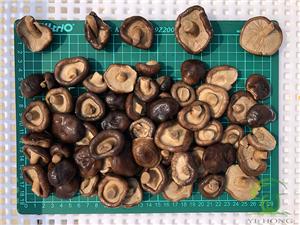
The quality of shiitake mushrooms does not begin in the factory, but on the mushroom logs in the forest. High-quality salted shiitake mushrooms require thick caps with inwardly rolled edges. At brinedfungi's partner bases, we strictly control the timing of harvesting. The ideal harvesting stage is when the cap is 60-70% open, at which point the flesh is most plump and maintains excellent structural integrity during the brine pickling process. If harvested too late, the caps become thin and the edges fully unfolded, making them extremely prone to breakage during subsequent mixing and transportation, resulting in substandard drained weight.
II. Core Grading Specifications: The Business Logic of 2-4cm and 4-6cm
In our product brochure, 2-4cm and 4-6cm are two core specifications, each corresponding to completely different market applications:
1. 2-4cm Specification: Synonymous with Delicacy and Chewy Texture
This size of shiitake mushroom is often called "button shiitake." Due to its small size and high cell density, its texture after desalination is closest to that of freshly harvested mushrooms. It is mainly used in high-end restaurant chains and whole-grain canned fungi. In industrial production, the 2-4cm specification does not require additional cutting, significantly reducing labor costs in food factories. They are commonly found in frozen vegetable platters, semi-finished Japanese stews, and canned chilled mushrooms in the European market.
2. 4-6cm Size: A Balance Between Profitability and Processing Flexibility
This is the most favored "all-rounder" size for industrial customers. For pizza ingredient factories, soup base producers, and vegetarian patty manufacturers, 4-6cm offers better value for money. These shiitake mushrooms have thick caps, suitable for mechanized slicing or dicing. In brine, larger shiitake mushrooms release their flavor compounds more slowly, ensuring that the core flavor remains locked within the fibers during long global sea voyages.
III. Deep Processing: Cost Accounting for Whole, Sliced, and Stem-Cut Mushrooms
When purchasing brine-cured shiitake mushrooms, the choice of form often determines the final profit margin. Brinedfungi offers the following three customized forms:
Whole: Retains the natural shape of the shiitake mushroom. Suitable for catering suppliers who need to showcase the integrity of the ingredients on-site.
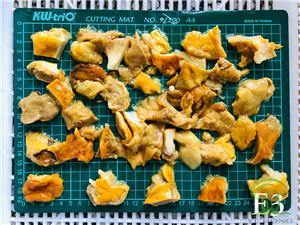
Stem-Cut: This is a key technical point. While shiitake mushroom stems are rich in fiber, they have a firm texture. We offer mushrooms with 1cm short stems, 0.5cm short stems, or completely stemless. Stemless shiitake mushrooms have a higher filling rate in the container, meaning you get more "effective cap flesh" for the same shipping cost.
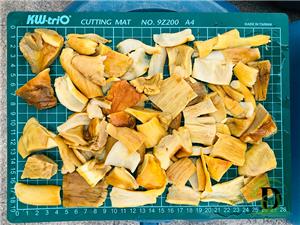
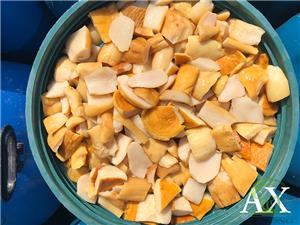
Slices: We use precision blades to slice the mushrooms to a uniform thickness of 4mm-6mm. This directly eliminates the most expensive cutting and preparation step in food processing, and the brine allows for 360-degree penetration, resulting in more even preservation.
IV. Technical Parameters of the Brine Process: pH Value, Salinity, and Osmotic Pressure
Brine preservation is not simply "dropping mushrooms into brine." At Brinedfungi's factory, this involves a complex biochemical process:
Blanching: The temperature must be controlled at 95-98℃, and the time is precise to the second depending on the size. This step is to inactivate polyphenol oxidase, preventing the shiitake mushrooms from turning black, and simultaneously expelling excess air from the cells.
Saturation Control: We use a saturated brine solution of 22-25 Baume degrees. The high osmotic pressure causes water to be drawn out of the mushroom flesh, while salt enters. This process requires a 15-20 day "stabilization period," and products that have not reached this period must not be shipped.
pH Adjustment: To prevent browning and inhibit halophilic bacteria, we maintain the environmental pH between 4.5 and 5.2.
Professional Procurement Tip: A simple way to identify high-quality brine-treated shiitake mushrooms is to observe the rehydration rate after desalination. High-quality Brinedfungi shiitake mushrooms, after desalination, can regain more than 110% of their original drained weight, and the cap edges still maintain their inward curl and elasticity, without any soft or mushy feel.
V. Global Supply Chain and ESG Standards
As a Brinedfungi customer, you are not only buying mushrooms, but also accessing a compliant supply chain. Our products comply with HACCP and ISO22000 standards, and each batch is tested for heavy metals (such as lead and cadmium) and pesticide residues. In terms of sustainable development, we use a circulating water cleaning system and convert the cut-off waste mushroom stems into organic fertilizer to achieve closed-loop production.