How to Choose Shiitake In Brine for Food Manufacturing and Wholesale Supply
For food manufacturers, distributors, restaurant suppliers and ingredient buyers, selecting the right Shiitake In Brine is not simply a matter of comparing prices. The product has to fit the intended application, production process, packaging format, storage requirements and purchasing volume.
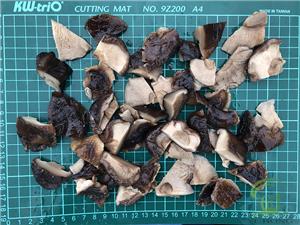
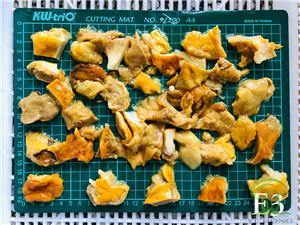
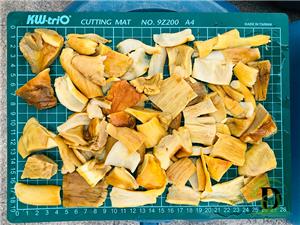
Brined shiitake is commonly used as a processed mushroom ingredient because it is supplied in a ready-preserved format and can be incorporated into a range of food applications. Depending on the specification, buyers may purchase whole mushrooms, pieces, strips or cubes. The appropriate format depends on whether the buyer needs visual presentation, further cutting, sauce production or high-volume food processing.
This guide explains the main factors B2B buyers should check before placing a bulk order and shows how to evaluate a Chinese supplier more systematically.
What Is Shiitake In Brine?
Shiitake in brine is shiitake mushroom preserved in a salt-water solution after processing. The preservation process is intended to extend storage life while maintaining a useful mushroom texture and flavor profile for subsequent food production.
For industrial buyers, the most important point is that brined shiitake should be evaluated as a food ingredient specification, rather than only as a finished retail food. Size, cut, ingredient declaration, packaging, drained weight, storage conditions, shelf life and quality consistency all influence the real purchasing value.
Why Food Manufacturers Buy Brined Shiitake
Fresh mushrooms can require sorting, trimming, cutting and rapid processing. A preserved ingredient can simplify some of these steps and make procurement easier for manufacturers that need a stable raw-material format.
Convenient processing: Depending on the cut, the mushroom may require less preparation before use.
Consistent specification: A defined size or cut helps production lines standardize recipes.
Bulk packaging: Drum packaging is suitable for commercial ingredient handling.
Multiple applications: Brined shiitake can be used in sauces, soups, prepared foods, pizza toppings and other processed-food applications.
Longer storage window: Brining provides a preservation method that can be useful for industrial inventory planning.
1. Check the Mushroom Size
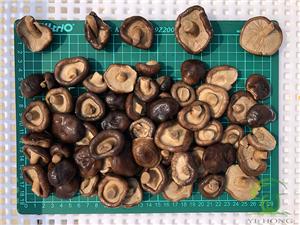
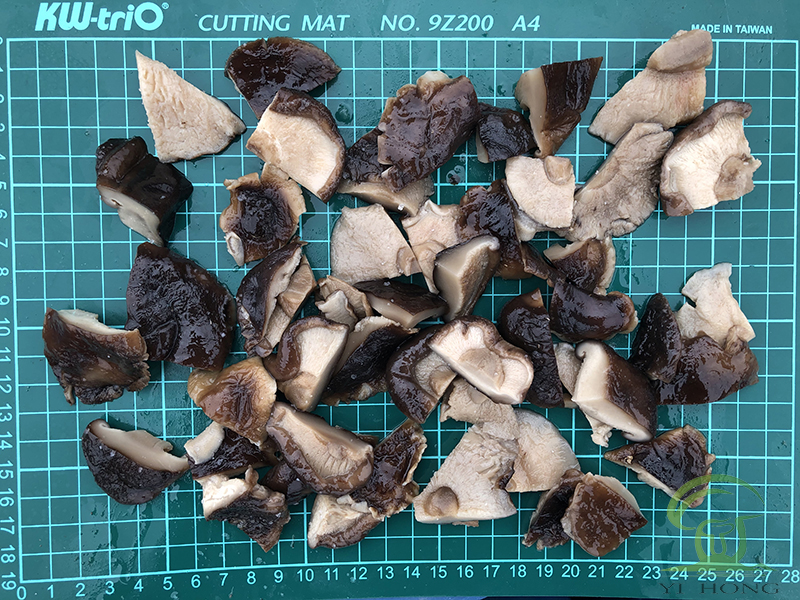
Size is one of the first specifications to confirm with a supplier. For example, the YIHONG product range includes a 2–4 cm shiitake specification. The company states that its 2–4 cm product is selected for size and appearance and supplied for different cooking applications.
For buyers, the important question is not whether one size is universally “best.” Instead, ask whether the size matches the final application. Whole or smaller mushrooms can be suitable when appearance matters, while pieces, strips or cubes may be more efficient for sauces, fillings and further processing.
2. Decide Between Whole, Strips, Cubes and Other Cuts
Cutting specification can directly affect labor and yield. If your production line already has cutting equipment, whole mushrooms may provide greater processing flexibility. If labor efficiency is a priority, pre-cut formats can reduce preparation work.
Before ordering, specify:
Whole or cut mushroom
Target diameter or piece size
Strip or cube dimensions where applicable
Whether stems are included
Acceptable variation in size
Visual requirements for caps and pieces
3. Review Ingredient and Brine Specifications
Do not evaluate a brined mushroom only by its appearance. Request the supplier's current product specification and confirm the ingredient declaration, brine characteristics, processing method and any market-specific requirements.
The product information published by YIHONG identifies its fresh shiitake in brine as a product made from fresh shiitake mushrooms and salt-water processing. For an actual purchase, buyers should request the latest specification sheet and applicable food-safety documentation rather than relying only on a website description.
4. Compare Net Weight, Drained Weight and Gross Weight
For drum-packed preserved mushrooms, gross drum weight does not tell you how much usable mushroom you are buying. A professional quotation should make clear the relationship between product weight, drained weight, packaging weight and brine.
Ask the supplier to state:
Net mushroom weight per drum
Drained weight
Gross weight
Drum dimensions or packaging type
Number of drums per container
Loading quantity for the proposed shipment
This makes supplier-to-supplier price comparisons much more meaningful.
5. Confirm Shelf Life and Storage Conditions
Shelf life should always be reviewed together with storage conditions and the supplier's actual label or specification. A longer stated shelf life is useful only when the product is manufactured, packaged, transported and stored according to the required conditions.
For example, YIHONG's brined Nameko product pages state a 24-month shelf life, while individual shiitake product pages should be checked for the exact specification being purchased. Buyers should request the current shelf-life statement for their selected shiitake SKU before signing a contract.
6. Evaluate Supplier Production Capability
For B2B purchasing, supplier capability is often more important than a small difference in unit price. A factory should be able to explain how raw materials are selected, how mushrooms are graded, how salting and packaging are controlled, and how finished products are inspected.
YIHONG currently lists its fresh shiitake in brine with a stated supply capacity of 150 tons per month and a stated delivery time of 20 days. These are useful starting points for a purchasing discussion, but buyers should still confirm the capacity, lead time and availability for their specific order quantity and specification.
7. Ask for Samples Before a Bulk Order
A sample is especially important when the product will enter an existing recipe or production line. The sample should be evaluated under the same conditions in which the final product will be used.
Check:
Appearance and color
Cap and stem condition
Size consistency
Texture after cooking
Salt perception after the planned preparation process
Drained weight
Foreign matter and visible defects
Performance in the intended recipe
Common Applications of Brined Shiitake
Brined shiitake can serve different roles in commercial food production. Typical applications include mushroom sauces, soups, prepared meals, pizza toppings, fillings and other processed foods. The correct grade depends on the application rather than on a generic “premium” label.
For a sauce manufacturer, consistent pieces may be more important than attractive whole caps. For a food-service distributor, whole or uniform mushrooms may be more commercially useful. For a factory producing fillings, a pre-cut format may reduce preparation time.
Why Buying Directly From a China Factory Can Be Useful
Direct factory sourcing can simplify communication about specifications, packaging and production schedules. It can also make it easier to request customized cutting or grading when the supplier has the necessary processing capability.
YIHONG is located in Anshan, Liaoning, China, and its website presents shiitake in brine as one of its core product categories. The company provides product inquiries through its website and lists its contact information for wholesale buyers.
B2B Buyer Checklist Before Requesting a Quote
| Item | What to Confirm |
|---|---|
| Mushroom type | Shiitake variety and raw material specification |
| Size | For example, 2–4 cm or another agreed specification |
| Cut | Whole, strips, cubes or other format |
| Ingredients | Mushroom, salt, water and any other declared ingredients |
| Packaging | Drum type, net weight and drained weight |
| Shelf life | Current specification and storage conditions |
| Quality documents | Documents required for your destination market |
| Lead time | Production schedule for the requested quantity |
| Loading | Estimated quantity per container |
| Sample | Pre-shipment sample or production sample requirements |
How to Request a More Accurate Quote
Instead of sending only “Please quote shiitake in brine,” provide the supplier with your target size, cut, packaging, estimated monthly quantity, destination country and intended application.
A clear inquiry might include: “We are looking for bulk shiitake in brine for food manufacturing. Please quote your 2–4 cm specification, including drained weight per drum, gross weight, packaging, shelf life, ingredient specification, MOQ, lead time and loading quantity per 20-foot container.”
This gives the supplier enough information to prepare a commercially useful quotation and reduces repeated questions during the sourcing process.
Conclusion
The best Shiitake In Brine for a B2B buyer is the product that fits the buyer's application, processing line, packaging requirements and target cost—not necessarily the product with the lowest quoted price.
Before placing a bulk order, compare the actual mushroom specification, cut, drained weight, packaging, shelf life, quality controls and supplier capacity. If you are sourcing from China, requesting a sample and a complete product specification is one of the simplest ways to reduce purchasing risk.
Looking for bulk Shiitake In Brine from China?
Send your required mushroom size, cut, packaging, quantity and destination market. YIHONG can provide product information and a quotation based on your purchasing requirements.
Contact: yh_2002@126.com