The Ultimate Guide to Importing Salted Nameko Mushrooms from China (2026 Edition)
In the global food manufacturing and catering industry, sourcing stable, high-quality, and cost-effective raw materials is the key to maintaining a competitive edge. Among industrial edible fungi, Salted Nameko mushrooms (Pholiota nameko) have become an indispensable ingredient for canned soup manufacturers, ready-to-eat meal producers, and premium Asian restaurant chains.
However, importing bulk salted mushrooms requires profound product knowledge. How do you distinguish between grades? What is the standard drained weight? In this comprehensive 2026 guide, we unveil the industry secrets of brined Nameko mushrooms to help your procurement team make the smartest purchasing decisions.
Why Choose Salted Nameko Over Fresh or Frozen?
Many food processors ask: Why should we buy brined mushrooms instead of fresh or IQF (Individually Quick Frozen)? The answer lies in logistics, shelf life, and texture preservation.
Extended Shelf Life: Fresh Nameko mushrooms spoil within days. By utilizing a scientific brining process with a salinity level of 20%-22%, salted Nameko can be safely stored at room temperature for 12 to 24 months.
Reduced Shipping Costs: Frozen mushrooms require expensive cold-chain logistics, which drastically increases the landed cost. Salted mushrooms in drums can be shipped via standard dry sea freight, saving up to 40% in shipping expenses.
Texture Retention: The salt-curing process perfectly locks in the natural crispness and the signature gelatinous coating of the Nameko, which is essential for thickening soups and sauces naturally.
Understanding Salted Nameko Quality Grades.
Pricing in the B2B mushroom market is strictly dictated by quality grades. When requesting a quote, you must specify the grade that fits your end product. Here is the international standard:
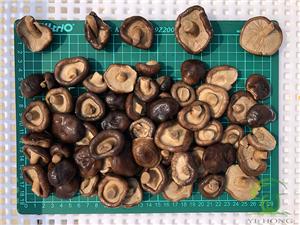
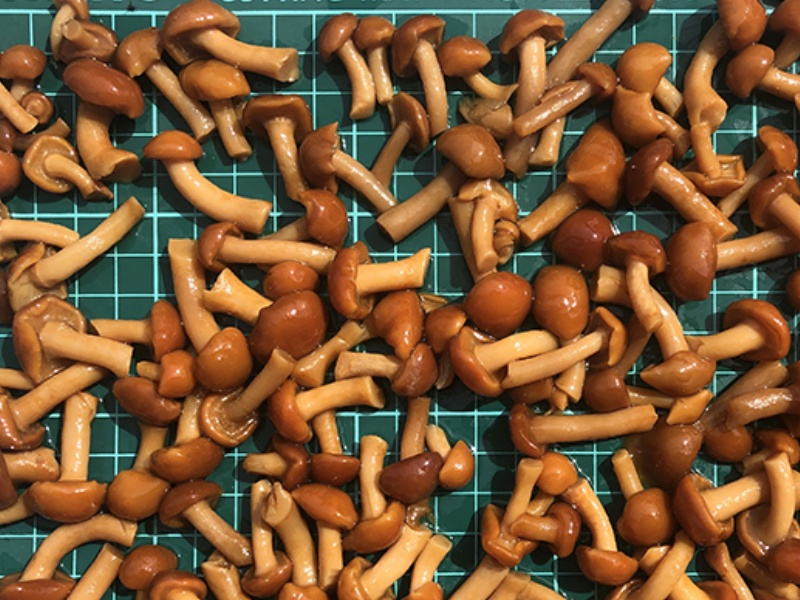
Grade A (Premium Closed Cap): This is the highest quality. The mushroom caps are completely un-ruptured and tightly closed, with a diameter typically ranging from 1.0cm to 2.5cm. The stems are trimmed to a uniform length of 2-3cm. It is the top choice for premium glass-jar retail packaging and high-end Japanese cuisine.
Grade B (Half-Open Cap): The protective membrane under the cap has broken, and the cap is partially open. It retains excellent flavor and texture but is more economical. Ideal for industrial catering and mass-market canned soups.
Grade C / Flat Cap: The caps are fully opened and mature. While visually less appealing, they are perfect for food processors making mushroom purees, sauces, or vegan fillings, offering the best cost-efficiency.
Standard Export Packaging and Yield Rate (Drained Weight).
For bulk export, Salted Nameko mushrooms are packed in food-grade blue plastic drums.
Gross Weight (G.W.): Approx. 70(±2-3kg) kg per drum.
Net Weight (N.W.): 50 kg per drum (this includes the mushroom and the brine).
Drained Weight / Yield Rate: A common concern for buyers is the actual yield. A reputable supplier will guarantee a stable drained weight. Typically, after draining the brine, the solid mushroom weight accounts for 60% to 70% of the net weight, depending on the agreed-upon specifications. We strictly reject the deceptive practice of "water injection," ensuring you pay for pure ingredients, not saltwater.
Essential Export Certificates for Customs Clearance.
To ensure smooth customs clearance in regions like the EU, the USA, and Southeast Asia, your Chinese supplier must provide a complete set of documentation. For every shipment, we provide the Commercial Invoice, Packing List, Bill of Lading, Phytosanitary Certificate, and Health Certificate.
Are you looking to secure a reliable supply chain for Salted Nameko in 2026?
Don't let inconsistent quality ruin your production lines.
Contact Us Today to request our latest B2B price list and apply for a Commercial Sample. Let our quality speak for itself.- Industry News
- Product News
- Company News
- Video