Stop Wasting Time on Prep: Why Top Food Manufacturers Are Switching to Brined Shiitake Mushrooms
The Unseen Squeeze on Food Manufacturing Margins
If you are a procurement manager, a food scientist, or an operations director at a food manufacturing facility, you are likely facing a perfect storm in 2026. Global supply chains remain unpredictable. Agricultural commodity prices are experiencing unprecedented volatility due to climate shifts. But perhaps the most pressing challenge of all is the skyrocketing cost of labor combined with chronic worker shortages.
In the highly competitive food industry—whether you are producing ready-to-eat (RTE) meals, canned soups, frozen dumplings, plant-based meats, or premium savory sauces—protecting your profit margins without compromising on flavor and quality is the ultimate daily battle.
For decades, food manufacturers have relied on either fresh or dried shiitake mushrooms to deliver that sought-after umami flavor. However, handling fresh and dried mushrooms is incredibly labor-intensive. They require meticulous cleaning, sorting, hydration, and processing—steps that drain time, water, and manpower.
Enter the game-changing ingredient that top-tier food manufacturers, industrial caterers, and restaurant chains are quietly adopting: Wholesale Brined Shiitake Mushrooms (Shiitake in Brine).
In this comprehensive guide, we will pull back the curtain on why making the switch to brined shiitake mushrooms is one of the most profitable operational decisions your facility can make. We will explore the hidden costs of traditional mushroom sourcing, dive deep into the science of brining, analyze the spectacular return on investment (ROI), and provide you with an actionable roadmap for sourcing the highest quality bulk mushrooms for your production line.
Chapter 1: The Hidden Costs of Fresh and Dried Mushrooms in Industrial Production
To understand the immense value of brined shiitake, we must first examine the deep-rooted inefficiencies of traditional mushroom ingredients in a large-scale commercial kitchen or manufacturing plant. It is never just about the price per kilogram; it is about the Total Cost of Ownership (TCO) of the ingredient.
1.1 The Fresh Mushroom Dilemma
Fresh shiitake mushrooms are fantastic for a local farm-to-table restaurant, but they are an operational nightmare for a large-scale food factory.
· Shelf-Life Anxiety: Fresh mushrooms have a shockingly short shelf life. Even under perfect refrigeration, they begin to degrade, lose moisture, and develop bacterial slime within days. This forces manufacturers into a tight "Just-In-Time" inventory model, which is highly vulnerable to delivery delays.
· Massive Yield Loss: Fresh mushrooms are roughly 85-90% water. When you cook them down for a sauce or a filling, your yield shrinks dramatically. You are essentially paying freight and storage costs for water.
· Debris and Dirt: Fresh mushrooms grow in organic substrates. They arrive at your loading dock covered in dirt, requiring rigorous washing stations.
· Price Volatility: A sudden frost or excessive rain in the growing region can cause the spot price of fresh shiitake to double overnight. You cannot forecast your annual budget accurately when your core ingredient's price looks like a volatile stock chart.
1.2 The Dried Mushroom Trap
Many manufacturers turn to dried shiitake mushrooms to solve the shelf-life issue. While they last longer, they introduce a host of new operational bottlenecks.
· The Rehydration Bottleneck: Dried mushrooms cannot be thrown directly into most industrial mixers. They require hours of soaking. This means your facility needs massive soaking vats, consuming valuable floor space.
· Food Safety Risks During Soaking: Leaving large vats of mushrooms soaking in water at room temperature creates a prime breeding ground for bacteria if not strictly monitored, leading to potential HACCP (Hazard Analysis Critical Control Point) violations.
· Inconsistent Hydration: Depending on the thickness of the cap, some mushrooms will hydrate perfectly while others remain tough and chewy in the center, leading to inconsistent product texture for your end consumer.
· Labor-Intensive Prep: After soaking, workers still need to manually remove tough stems (if not bought stemless), wash away grit trapped in the gills, and slice or dice them.
When you calculate the cost of water, electricity for soaking vats, space allocation, and the hourly wages of workers tasked with washing and chopping, the "cheap" dried mushroom suddenly becomes remarkably expensive.
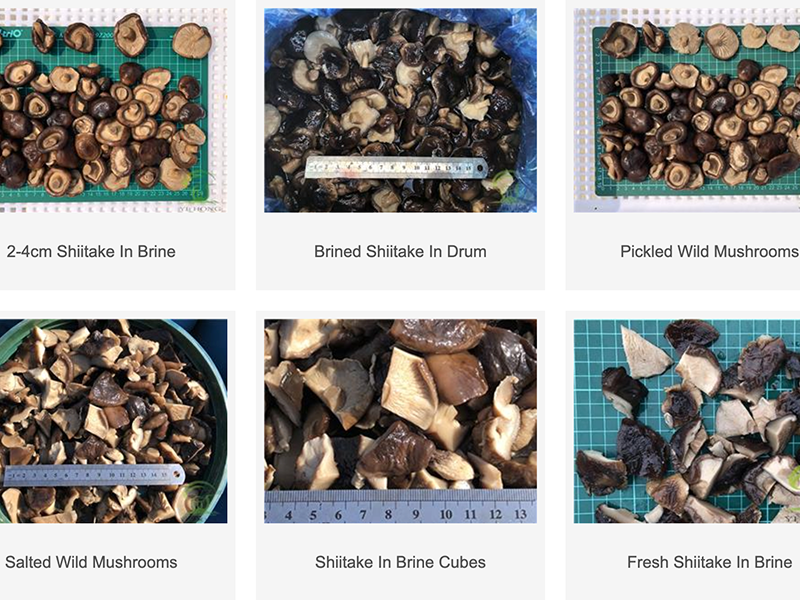
Chapter 2: What Exactly Are Brined Shiitake Mushrooms? (The Process & Science)
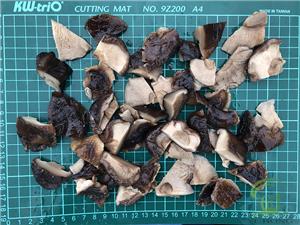
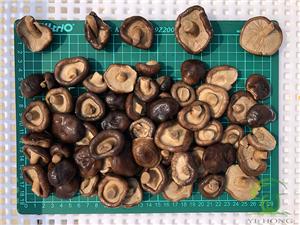
Brined Shiitake Mushrooms are premium, freshly harvested mushrooms that undergo a highly controlled preservation process using a saline (saltwater) solution. This ancient preservation method has been modernized and perfected for industrial B2B applications.
As a leading B2B supplier, our factory follows a stringent, multi-step process to transform raw mushrooms into the perfect industrial ingredient:
1. Peak-Harvest Selection: We source shiitake mushrooms at the exact moment their caps are perfectly rounded and thick, ensuring maximum umami flavor and a meaty texture.
2. Instant Cleaning & Grading: Within hours of harvest, the mushrooms are mechanically and manually cleaned to remove all substrate debris. They are then run through precise grading machines to separate them by cap diameter (e.g., 2-3cm, 3-4cm, 4-5cm, 5cm+).
3. Blanching: The mushrooms undergo a brief, high-temperature blanching process. This deactivates enzymes that cause browning and degradation, locking in the natural color and firm texture.
4. The Brining Process: The blanched mushrooms are submerged in a scientifically formulated high-concentration sodium chloride (salt) solution. Sometimes, a trace amount of citric acid is added to optimize the pH level and maintain a bright, appetizing color.
5. Curing and Equilibration: The mushrooms rest in the brine until the salinity penetrates the cellular structure entirely. This creates an environment where spoilage microorganisms and pathogens absolutely cannot survive.
6. Bulk Packaging: The finished product is packed into heavy-duty, food-grade plastic drums (typically 50kg net drained weight) along with the brine, sealed airtight, and prepped for global ocean freight.
The result? An ingredient that retains the robust, meaty texture of a fresh mushroom, the intense umami of a dried mushroom, but requires absolutely zero structural prep from your labor force.
Chapter 3: 6 Game-Changing Benefits for Top Food Manufacturers
Why are global brands making the transition? Here are the six primary reasons why sourcing wholesale brined shiitake is the ultimate competitive advantage.
Benefit 1: Zero Structural Prep Time Slashes Labor Costs
In a commercial facility, every minute a worker spends handling raw materials eats into your profit margin. Brined shiitake mushrooms arrive at your factory pre-cleaned, pre-graded, and visually perfect. Whether you order whole caps, pre-sliced mushrooms, or diced cubes, they are ready to be desalted and dropped straight into your cooking vessels. You can literally eliminate the washing, sorting, and slicing stages from your production line, allowing you to reallocate labor to higher-value tasks.
Benefit 2: 100% Consistency in Size, Texture, and Yield
Your brand's reputation relies on consistency. If a consumer buys a can of your mushroom soup today, they expect it to taste and feel exactly the same as the can they bought six months ago. Fresh mushrooms vary wildly by season. Brined mushrooms, however, are strictly graded. If you order a drum of 3-4cm whole brined shiitake, you will receive exactly that—thousands of identical, perfectly thick, aesthetically pleasing caps. Furthermore, because they are already saturated, their volume and yield remain incredibly stable during your cooking process.
Benefit 3: Extended Shelf Life (Up to 2 Years)
Supply chain disruptions are the nightmare of every procurement officer. Brined shiitake mushrooms offer an unparalleled shelf life of 12 to 24 months when stored properly in their unopened drums, even at ambient room temperatures. You do not need expensive cold storage or freezer warehouse space. This long shelf life allows you to buy in massive bulk quantities, securing lower container-load pricing and completely eliminating the stress of ingredient spoilage.
Benefit 4: Complete Immunity to Price Volatility
Because you can buy a year's supply of brined mushrooms and store them easily, you can lock in your ingredient costs. You are no longer at the mercy of seasonal fluctuations, bad weather in the growing regions, or sudden spikes in fresh produce prices. This makes financial forecasting and profit margin calculations highly predictable.
Benefit 5: Superior Texture Retention
Unlike freezing, which can rupture the cell walls of mushrooms and turn them mushy upon thawing, the brining process preserves the structural integrity of the shiitake. The high salt concentration fortifies the cell walls. Once desalted, the mushrooms offer a firm, satisfying, "meaty" bite that holds up perfectly in high-heat industrial retorts, canning processes, and long-simmering sauce vats.
Benefit 6: Simplified Inventory and Space Management
Standardized 50kg drums are stackable, durable, and highly space-efficient. They are easy to move with standard forklifts and pallet jacks. Compared to the massive, bulky sacks of fresh mushrooms or the sprawling vats required to soak dried mushrooms, drums of brined shiitake dramatically optimize your warehouse footprint.