Shiitake Mushroom Blocks vs Whole Mushrooms: Which Format Is Better for Food Factories?
For food factories, the format of a mushroom ingredient can influence labor, processing time, yield and recipe consistency. Buyers comparing shiitake mushroom blocks with whole mushrooms should therefore look beyond the purchase price and consider how each format performs on the production line.
The best choice depends on the recipe, equipment, required dimensions, labor costs and final product. This guide explains how B2B buyers can evaluate different shiitake formats before placing a bulk order.
What Are Shiitake Mushroom Blocks?
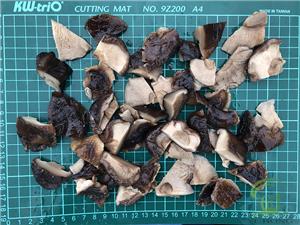
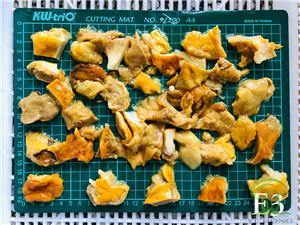
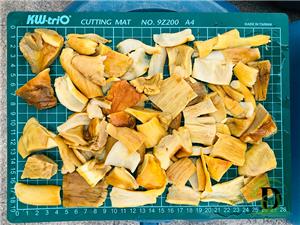
The term “shiitake mushroom blocks” can refer to a processed mushroom format intended for further food manufacturing. Because terminology is not always standardized between suppliers, a buyer should request exact dimensions and a sample instead of relying only on the product name.
When the product is supplied in brine, the buyer should also confirm the preservation method, drained weight and drum specification.
Whole Shiitake vs Processed Formats
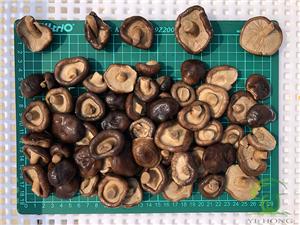
Whole mushrooms offer flexibility. The factory can sort, trim and cut them according to different recipes. This can be useful when one raw material is used across several products.
Processed formats can reduce preparation work when the same mushroom dimension is required repeatedly. This can be particularly useful for factories producing sauces, fillings, prepared foods or other products where mushroom appearance is less important than consistent particle size.
Advantages of Whole Mushrooms
Flexible for different recipes.
Useful when whole mushroom appearance is required.
Allows the buyer to control the cutting process.
Suitable for factories with their own sorting or cutting equipment.
Advantages of Pre-Cut or Block Formats
Can reduce preparation labor.
Can simplify batching and portion control.
Can provide a defined particle size for repeat production.
May reduce the number of processing steps at the buyer's facility.
What Should Buyers Compare?
A proper comparison should include purchase price, labor, process loss, usable yield and production efficiency.
Total ingredient cost = Purchase cost + preparation cost + process loss + handling cost
A pre-processed mushroom can have a higher purchase price but still be more economical if it reduces labor and waste. Conversely, a factory with efficient internal cutting equipment may prefer whole mushrooms.
Define the Dimensions Clearly
If you need blocks, pieces, strips or cubes, define the target dimension and acceptable tolerance. Do not assume that different suppliers use the same definition for “block.”
Also specify whether stems are included, whether trimming is required and how much size variation is acceptable.
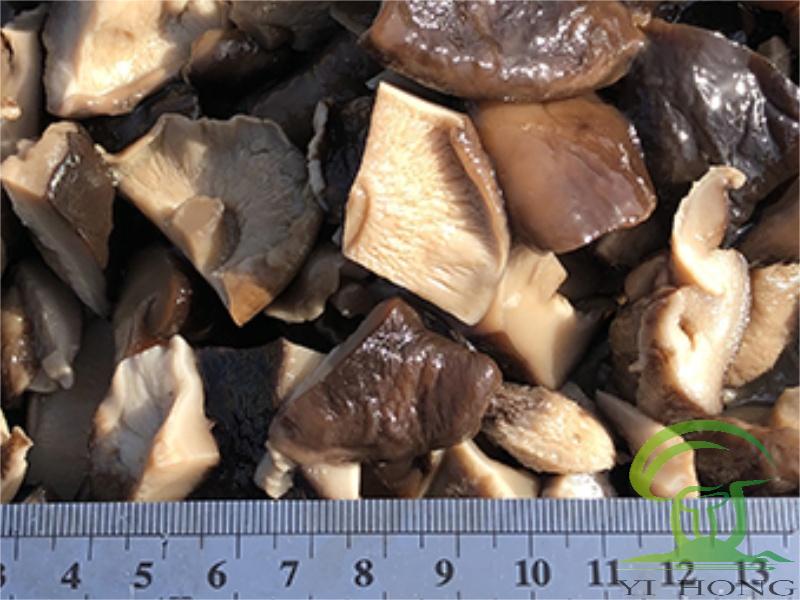
Brined Shiitake and Drained Weight
When the mushroom is preserved in brine, the purchase specification should distinguish between mushroom weight and total drum weight. The usable mushroom quantity is represented by drained weight, not gross weight.
This is particularly important when comparing different processed formats. A buyer should evaluate how much usable mushroom is received and how much additional preparation is required before the ingredient enters production.
Which Format Fits Different Applications?
| Application | Potential Format | Main Priority |
|---|---|---|
| Sauce production | Pieces, strips or cubes | Consistent dimensions and usable yield |
| Prepared foods | Pieces or strips | Batch consistency |
| Pizza toppings | Whole small mushrooms or uniform pieces | Appearance and portion control |
| Food service | Whole or specified cuts | Ease of preparation |
| Further processing | Whole or flexible cuts | Compatibility with equipment |
Quality Checks for Shiitake Mushroom Blocks
Measure actual piece dimensions.
Check size variation across multiple samples.
Inspect broken or excessively small pieces.
Evaluate texture after cooking.
Check visible defects and foreign matter.
For brined products, measure drained weight.
Run a production trial using the final recipe.
Questions to Ask a Supplier
Before approving a new source, ask:
What exactly is the product format?
What are the dimensions and tolerance?
Is the mushroom whole, cut or further processed?
Is it fresh, brined or frozen?
What is the ingredient declaration?
What packaging is available?
What is the drained weight if supplied in brine?
What is the shelf life?
What is the MOQ?
What is the normal production lead time?
Can a production sample be provided?
Why a Production Trial Matters
Laboratory or visual inspection alone cannot always determine whether a mushroom format is suitable for commercial production. A production trial can reveal whether the size works with your equipment, whether the texture remains acceptable after cooking and whether the ingredient integrates efficiently into the recipe.
For recurring orders, it is also useful to keep an approved reference sample or specification so that future shipments can be compared against the agreed standard.
How to Build a Better RFQ for Shiitake
Instead of writing only “Please quote shiitake mushroom blocks,” provide the supplier with the intended application and technical requirements.
Example: “We are a food manufacturer looking for brined shiitake in a consistent pre-cut format for sauce production. Please provide available block, cube or strip dimensions, drained weight per drum, packaging, shelf life, MOQ, lead time and price for our destination port.”
When Whole Mushrooms May Be the Better Choice
Whole mushrooms may be preferable when the buyer needs several different cuts, wants to control processing internally or has existing equipment that can handle sorting and cutting efficiently.
They can also be the better choice when the final product needs whole mushroom appearance or when the factory wants maximum flexibility in raw-material utilization.
When Pre-Cut Formats May Be Better
Pre-cut formats can be attractive when the recipe always uses the same dimensions, labor costs are significant or the factory wants to simplify preparation. They can also help standardize the ingredient input when the supplier maintains a consistent cutting specification.
Shiitake mushroom blocks and whole mushrooms can both be useful for industrial food production. The correct choice depends on the complete cost and production requirements rather than the raw mushroom price alone.
For brined products, compare the format together with drained weight, packaging, shelf life, size tolerance and supplier consistency. A sample and production trial are recommended before committing to a large recurring order.